
How to Play
 | |
|---|---|
| Quick Reference Guide | |
| Download PDF | |
| Version | 5.0 |
| Release Date | July 2024 |
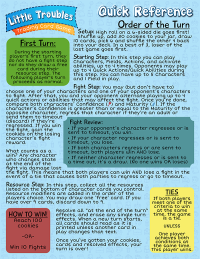
How to Win
- Reach 100 cookies
- Win 10 fights, or
- Play and achieve the conditions listed on an Alternate Win Condition card.
Ties
- Alternate win conditions supersede winning by Cookies or Fights. This means that if a player achieves an Alternate Win Condition at the same time their opponent achieves 100 cookies or wins 10 fights, the player that achieved the Alternate Win Condition would win.
- If both players simultaneously achieve an Alternate Win Condition, the game ends in a tie.
- If Both players achieve a non-alternate win condition at the same time or, in case of tournament play, the time in the round is called and no player has won; the tie-breaker rules listed below will be used to determine the winner:
- Each player calculates their percentage of Cookies and Fights Won compared to the goal of 100 Cookies and 10 Fights Won. Each of these percentages is capped at 100%.
- The 2 percentages are added together. Whichever player has a higher total percentage wins the game.
- If both players have the same tie-breaker value, the game will end in a tie.
Starting a Game/Match and Initial Setup
- Choose a randomized method (such as high roll on a six-sided die or rock-paper-scissors) to determine who goes first. The winner chooses whether they will go first or go second and have 2 extra cookies to start with.
- Shuffle your deck, add 30 cookies, or 32 if you go second, to your jar, and draw 10 cards. You can then choose to:
- Pick 6 to keep and shuffle 4 back into your deck, or
- If the format allows it, take a mulligan. For that, you shuffle all 10 cards back in to the deck and then draw 10 new cards, and repeat the process above.
- Once all players are ready and have their starting hands, shuffle one last time and the game can begin.
- In a best of 3, loser of the last game decides who goes first.
Order of the Turn
First Turn
- During either player's first turn, they do not have a fight phase.
Build Phase
- In this phase, you may play Characters, Actions, Fields, Toys, Scenes, Goals, and activate abilities, up to 4 times.
- Opponents may play up to 4 Quick Actions / Quick Abilities during this step.
- Turn player will have priority to play a card first. After that, they will pass the priority to their opponent, who will be able to play a card. This repeats until both players play 4 cards each or both pass priority without playing a card.
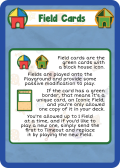
- You can have up to 5 Characters, 5 Toys, 1 Field and 1 Goal in play.
- Some cards may modify this limits, or the layout of your or your opponent's playground.
- After the Build Phase, you will enter the Fight Phase.
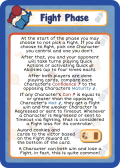
Fight Phase
- Before deciding if you want to pick a fight or not, both players will have the opportunity to play Quick Actions or activate Quick Abilities, up to 4 each.
- Then, you may (but don't have to, unless a card forces you to) choose one of your characters and one of your opponent's characters to fight.
- After that, you and your opponent alternate playing Quick Actions or Quick Abilities, up to 4 each, including those played prior to picking a fight.
- Once you're done, and if the fight isn't resolved by other means, compare both characters' Confidence and Maturity.
- If the character's Confidence is greater than or equal to the Maturity of the opposite character:
- regress that character if they're an adult, or
- send them to timeout (discard) if they're already regressed
- If you win the fight, gain the cookies on the losing character's fight reward
What counts as a win?
- Any character who changes state at the end of the fight via damage lost the fight.
- This means that both players can win AND lose a fight in the event of a tie that causes both parties to regress and/or go to timeout.
Fight Review:
- If your opponent's character regresses or is sent to timeout, you win.
- If your character regresses or is sent to timeout, you lose.
- If both characters regress or are sent to timeout, both players win AND lose.
- If neither character regresses or is sent to a timeout, it's a draw (no one wins OR loses).
Fight Loses
- If a card effect says that a player loses the current fight, their Character(s) in the fight will be regressed/sent to timeout and fight rewards will be given, unless otherwise specified.
Resource Phase
- In this step, you collect all the resources listed on the bottom of cards you control.
- By default, players will have a starting 1 cookie and 1 card resource count.
- Resource modifiers are added in the order if the player's choice.
- If after drawing cards, if any, you have over 9 cards, discard down to 9.
- Resolve all "at the end of the turn" effects, and erase any single-turn effects.
- When a new turn starts, all cards should read as printed unless another card in play changes that text.
- Once you've gotten your cookies, cards and resolved effects, your turn is over!
Card Sections
| Icon | Element | Description |
|---|---|---|
| Icon | Indicates the card type | |
 |
Cost | How many cookies you pay to play this card |
| Art | No game effect, But it looks cool! | |
| Ability | The way the card impacts the game. | |
 |
Confidence | Character's ability to win fights. (Attack) |
 |
Maturity | Character's ability to stay adult - or out of timeout (Defense) |
 
|
Resources | The number of cookies and cards you gain each resource phase |
  |
Fight Reward | The number of cookies you get if you win a fight against this character |
Card Types
| Icon | Type | Icon | Type |
|---|---|---|---|
 
|
Adult Character |   |
Adult Main Character |
  |
Regressed Character |   |
Regressed Main Character |
  |
Action |  |
Decisive Action |
  |
Quick Action |   |
Decisive Quick Action |
  |
Field |   |
Iconic Field |
 |
Global Iconic Field | ||
  |
Toy |   |
Shiny Toy |
  |
Scene |   |
Memorable Scene |
  |
Goal |   |
Great Goal |
 |
Pregame Action | ||
Note: players can have 3 of most cards per deck. However, players may only have 1 main / decisive / iconic / shiny / memorable prefixed card per deck.
Rules
Rule of One
No value can be zero. If a stat or cost would go below 1, it still functions as 1, and would read as: (-x) 1, unless its printed value is already 0.
Rule of Fun
(As important as the Rule of One) Make sure the ways you're engaging with the game, playspace and opponent foster a positive experience. If at ANY POINT during a game, elements of that game (beyond the board state) are preventing you from having fun, whether they are external or internal, express this and catch your breath. It's always better to delay a game by a minute to preserve the fun. Do Not Abuse This Rule.
Field of Play
Each player has 5 Character slots, 5 Toy slots, 1 Field slot and 1 Goal slot unless a card changes these values.
Card Replacement
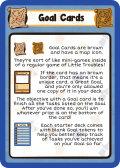
You can play a field even if you already have one in play. The existing field goes to Timeout. The same is true for Goal and Scene cards.
Toys
Toys stay in play after their cost is paid. Grabbing a Toy is a normal speed action unless otherwise indicated by a shooting-star icon (quick ability).
Emptying Your Draw Pile
If you run out of cards to draw, shuffle your Timeout - it becomes your new draw pile.
Scenes
Scenes stay in play after the cost is paid. Scenes can be played to any slot on the board (including the opponents side) and only affect the space they are played into.
Good Players Don't Interrupt
All cards in Little Troubles resolve in full before another card can be played. Even in the case of a 'Quick' card, there can't be any other cards being played in order for you to play a new one. If a card has an effect, for example "if a character would be regressed while this card is in play, restore it and regress this character instead", that happens as a part of playing the card.
Rules Cards
-
 1 - Turn Order
 -
 2 - Starting the Game
 -
 3 - Playing A Card
 -
 4 - Build Phase
 -
 5 - Fight Phase
 -
 6 - Resource Phase
 -
 7 - Victory Conditions
 -
 8- Action Cards
 -
 9 - Character Cards
 -
 10 - Field Cards
 -
 11 - Toy Cards
 -
 12 - Scene Cards
 -
 13 - Goal Cards


Game Formats
Constructed Play

Other Formats
Storyteller
For more information about Storyteller format, see the Storyteller page.